


Skid Steer Bucket
Factory Strength
Wiki Industrial Equipment Manufacturing Co., Ltd. is an enterprise focusing on mining machinery manufacturing. The company produces various types of mobile stacking conveyors, grain conveyors, mobile screening equipment, various types of skid loader accessories, excavator accessories, which are used in mining machinery, garden machinery, etc.
Professional Team
The company has carried out a number of R&D projects for its products and technologies, and has formed a professional R&D team to engage in R&D activities
Market Distribution
Main customers are distributed in the United States, Canada, Australia, Mexico and other countries.
Our Intellectual Property
18 intellectual property rights have been applied for, of which 2 software copyrights have been obtained, and another 16 utility models are being processed, to protect the company's products and technologies in all aspects.
What is Skid Steer Bucket
A skid steer bucket is a versatile tool that can be used in a variety of applications, whether on a farm or a building project. Its ability to move heavy loads, remove debris, and level terrain makes it an essential piece of equipment for many businesses.Let’s explore the different ways you can use a skid steer bucket to improve efficiency, save time and money, and get the job done right. And why you need to find a skid steer bucket for sale to meet your specific requirements.
-
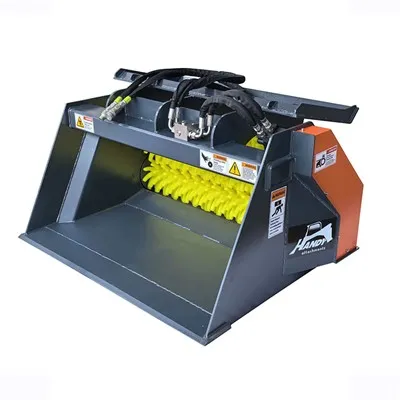 Screening Bucket For Skid SteerModel: HVSB48. Brand: Handy. Number of flexi-star: 83. 1 or smaller material will flow through.. Install the hydraulic protection device for the motor.. Overall size: L55 x W44 x H30. Requires highAdd to Inquiry
 -
 Skid Steer Screening BucketModel: HVSB72. Brand: Handy. 72 structure width. 64.5 Screening width. 7/8 cubic yards capacity. Hydraulic vibrating motor. Adjustable amplitude of vibration. Overall size: L72 x W 47.9 x H35.4.Add to Inquiry
 -
 Skid Steer Rock Screening BucketModel: HVSB72. Brand: Handy. 72 structure width. 64.5 Screening width. 7/8 cubic yards capacity. Hydraulic vibrating motor. Adjustable amplitude of vibration. Overall size: L72 x W 47.9 x H35.4.Add to Inquiry


Benefits of Skid Steer Bucket
Time and Cost Efficiency
One of the most significant advantages of screening buckets is their ability to streamline the material handling process. Traditional methods of material separation often require multiple machines, transportation, and processing stages, which can be time-consuming and expensive. Screening buckets eliminate the need for intermediate steps, reducing labor, fuel, and transportation costs.
On-Site Versatility
Screening buckets are highly versatile and can be used with various types of excavators, loaders, and backhoes. Their adaptability makes them suitable for a wide range of applications, from topsoil screening and landscaping to mining and quarrying operations. This on-site versatility minimizes downtime and maximizes productivity.

Environmental Impact
By processing materials directly on site, screening buckets contribute to a reduced carbon footprint. The elimination of multiple transportation trips and the associated emissions make them an eco-friendly choice. Moreover, the screening process enables the separation of recyclable materials, promoting sustainable waste management practices.
Increased Productivity
The efficiency of screening buckets can significantly increase productivity. These attachments can process large volumes of material in a short amount of time, allowing projects to progress swiftly. The real-time separation of materials also ensures that only the desired particles are collected, optimizing the final product quality.
Types of Skid Steer Bucket
Skid Steer Rake Buckets
Cleaning up your property is no easy feat, that is, unless you have a rake bucket attached to your skid steer. It can handle the toughest jobs, including removing heavy vegetation, moving stones and rocks, and sorting demolition materials and other debris from dirt. It's a must-have attachment for farmers, ranchers, and anyone who owns or manages land that needs to be cleared and maintained.
High Capacity Skid Steer Buckets
Some jobs need to be done quickly and efficiently so you can get on with your day. If you have a need to move large amounts of grain, fertiliser, or mulch, you need a bucket that can handle a large volume. A high capacity skid steer bucket attachment will not only provide you with the volume capacity that you need, but it will also make the job faster, easier, and more efficient. At the end of the day, that means less work and more productivity.
Skid Steer Grapple Buckets
Got a big job like demolition clean up, logs, rocks, shrubs, or bushes to move, or a load of waste to handle? A skid steer rock grapple bucket is the ideal tool for these types of hard-to-handle loads. Uneven loads aren't a problem since the grapple arms operate independently for superb load control. In fact, there's not much a grapple bucket can't handle, whether it's on your construction site, ranch, farm, or any other job site.
Self-Loading Concrete Mixer Bucket
Concrete can be difficult to work with at the best of times, and not having the right tools for the job could end in a poor quality concrete mix or even messy clean ups that can set you back for hours. Loading, mixing and delivering concrete across a work site is made easy with a skid steer concrete mixer.
Skid Steer Stump Removal Bucket
Removing old stumps and moving trees is a time-consuming, labour-intensive job if you don't have the right tools and equipment. A stump removal bucket for your skid steer allows you to easily clear the land, work on your landscape, and much more. The serrated edge and curved base make light work of cutting tree roots, digging trenches, and makes demolition like pulling up old asphalt and concrete a snap.
Application of Skid Steer Bucket
Clearing Debris
Clearing debris is one of the most common uses of a skid steer bucket. Whether it is cleaning up a construction site or a farm, the skid steer bucket can move large amounts of debris in a short amount of time.Using a bucket with teeth or a grapple attachment can help grab and pick up even the smallest pieces of debris.
Moving Materials
Moving materials is another common use for a skid steer bucket. The bucket's ability to pick up and move large amounts of material makes it ideal for moving soil, gravel, rocks, and other materials.You can also attach a pallet fork or a material handling arm, so the bucket can be used to move items like pallets, bales of hay, and even large trees.
Leveling Terrain
Leveling terrain is an important part of any construction or farming project. A skid steer bucket can be used to level terrain quickly and efficiently. You can tilt the bucket, adjust the level of the soil, and with a laser grading system, you can ensure a precise level of grading.
Digging and Excavating
With the right attachment, a skid steer bucket can be used for digging and excavating. You can use attachments like a backhoe or a trencher to dig holes, trenches, and ditches.
Snow Removal
In areas where snowfall is a common occurrence, a skid steer bucket can be used for snow removal. By attaching a snow blade or a snow blower, the bucket can push or blow snow away quickly and efficiently.This makes it an essential tool for businesses in areas that experience heavy snowfall.
Demolition
Demolition is another use for a skid steer bucket. With the right attachments, a bucket can be used to break up concrete, asphalt, and other materials. This can be done with a hydraulic hammer, a concrete breaker, or a rock crusher.
The Four Functions of a Skid Steer Bucket
Dozer — Push and Spread Dirt
Equipped with a powerful dozer blade and cutting edge, the four-in-one bucket is incredibly capable during dozing projects. These edges cut into the ground easily, allowing you to better push dirt and other materials across a job site. They’re also very effective at spreading out dirt or gravel over long distances. As such, they’ll come in handy during any type of landscaping, land clearing, construction, or agricultural task.
Bucket — Load Dump Trucks
Like their namesake, these diverse attachments also make great buckets for loading materials into dump trucks. Constructed with heavy-duty steel and a powerful hydraulics system, this attachment has an incredibly large capacity and unrivaled lifting power. Because of this, they’re essential for projects that require you to lift and carry larger quantities of material at once.
Grapple — Grab and Carry Larger Material
Another core function of the 4 in 1 skid steer bucket is as a grapple for lifting other types of material. While the bucket is very effective at handling dirt and other glandular resources, you may find yourself in situations where you need to lift oddly shaped items like rocks or brush. Four-in-one bucket attachments have two hydraulic cylinders that allow you to open the bucket. With them, you can clamp the jaws down on debris and carry it wherever you need.
Versatility – What You Need When You Need It
Above all, the four-in-one bucket attachment offers versatility during your jobs. Whether you’re handling a simple plowing project or complex land clearing for construction, this attachment can provide everything you need in one clean device. As such, there is no need to change attachments in the middle of the job or waste time between tasks.
Cutting Edge
The first step while screening the material is scooping it. It may not be obvious, but the cutting-edge of the bucket must fit the scooped material. However, if you want to use the bucket for various materials, there are bolt-on cutting edges available, which can be attached during the operation in the field.
Mesh Aperture
The mesh aperture needs to be adjusted to the size of the scooped material. Luckily, if you need diverse types of mesh apertures, it is possible to purchase custom meshes. It takes no more than 5 minutes to change it in the attachment.
The Number of Moving Parts
The general rule says that the more parts an attachment has the more chances there are that some of them might malfunction. If you cannot afford to lose any time or money, choose the screening bucket with fewer parts to avoid fouling, jamming, or tangling.
Spillage
The screening bucket can be fully loaded and will not spill any of the material, even when carried over long distances.
Mixing
If you replace the mesh with a mixing plate, your screening bucket changes into a mixer. It is especially useful in mixing concrete.
Loading
Nothing stands in the way of using a screening bucket as a regular bucket and simply moving material from one location to another. Screening buckets are known for their no-spillage features. It is especially useful when the operator wa.
How to Maintain Skid Steer Bucket
In order to ensure that your skid steer bucket functions properly, it is important to inspect it regularly for signs of wear and tear. If you notice any damage, contact a qualified technician to have the bucket repaired.Regularly inspecting your skid steer bucket will also help you to spot any potential problems early before they become serious.
It is also important to keep the bucket clean. After each use, remove any dirt, debris, or residue from the bucket. This will help to prevent premature wear and tear.Whatever residue is left on the bucket after each use can also attract dirt and debris, which can lead to clogs.
To maintain optimal performance, it is important to lubricate the skid steer bucket regularly.If you don't lubricate the bucket, the moving parts can rub together and cause damage.Lubricating the bucket will also help to prevent rust and corrosion.The best way to lubricate the bucket is to use a grease gun. Apply grease to all of the moving parts, including the pins, bushings, and hinge points.In addition to regularly lubricating the bucket, you should also grease the quick coupler. The quick coupler is what connects the bucket to the skid steer.
If any parts of your skid steer bucket are worn or damaged, it is important to replace them as soon as possible. Worn or damaged parts can cause the bucket to malfunction and may even pose a safety hazard.If you have any questions about how to care for your skid steer bucket, contact a qualified technician. They will be able to give you specific instructions and advise you on the best course of action.
Our Factory
VICKEY Industrial Equipment Manufacturing Co., Ltd. is a manufacturing company specializing in mining machinery. The company produces various types of Skid Steer Mulchers, grain conveyors, portable screening plants, and all kinds of skid steer attachments & excavator attachments, applied to mining machinery, garden machinery, and so on. Our products are exported overseas, the main customers are located in the United States, Canada, Australia, Mexico, and other countries, and has received praise from customers!


FAQ
We're professional skid steer bucket manufacturers and suppliers in China, specialized in providing the best custom service. We warmly welcome you to buy skid steer bucket for sale here from our factory. For price consultation, contact us.
skid steer bucket, skid steer screening bucket, skid steer rock screening bucket