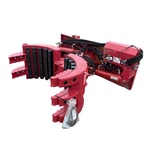
Stacker crane is an important lifting and conveying equipment for automated warehouses, representing the characteristics of automated warehouses. The warehouse where such machines are used can reach a height of up to 40m, mostly between 10-25m. The scope of application is to shuttle back and forth between the coal lanes of the automated warehouse, store items located at the entrance of the coal lane in the storage compartment, and transport items from the storage compartment to the entrance of the coal lane. These types of machinery and equipment must operate within the warehouse, and another machine needs to be configured to allow goods to enter and exit the warehouse.
1, Classification of stacker cranes
1. According to the presence or absence of sliding rails, it can be divided into trackless stacker cranes and rail stacker cranes.
2. According to different heights, it can be divided into low rise, medium rise, and high-rise residential types. The low rise stacker crane is designed for lifting heights below 5 meters and is mainly used in separate high-rise residential shelving warehouses and simple automated warehouses; Mid to high level stacker crane refers to a lifting height between 5m and 15m; High rise residential stacker crane refers to a lifting height of over 15m, mainly used in integrated high-rise shelving warehouses.
3. According to different levels of automation, stacker cranes can be divided into manual, fully automatic, and automatic types. Manual and semi-automatic stacker cranes have a driver's cab, while fully automatic stacker cranes do not have a driver's cab. Automatic control system equipment is selected for control, and fully automatic addressing and cargo handling can also be performed.
The important thing for the normal operation of a stacker crane is to maintain it well, ensuring that the machinery and equipment are sufficiently lubricated and the components are in excellent working condition. The key components of the car brake pads must be inspected to ensure that the stacker crane can be parked in a timely manner.
2, Key links of stacker crane
1. The gap between the brake pads of the stacker crane should not exceed 0.5mm, and it must be inspected to ensure the quality and operation of the project.
2. The gap between the brake pads of the stacker crane's walking motor should not exceed 0.5mm, and it must be inspected to ensure the quality and operation of the project.
3. Adjust the lubricating oil and grease of the reducer, set the limit and low limit for the amount of oil added, and carry out filling according to regulations to ensure safe production.
4. Adjust the damage value of the drum buffer, control the point, reach the upper and lower scales, and replace the shock absorber pad.
5. Adjust the lubricating oil of the reducer, filter the device indicator, and light up the alarm sign to replace the filter element.
6. Regularly maintain and replace the shock absorber gasket of the electric motor.
3, Characteristics of stacker crane
1. High work efficiency
Stacking crane is a professional equipment for three-dimensional warehouses, with high transportation speed and goods storage and retrieval time. It can perform inbound and outbound operations in a short period of time, and the higher starting speed of stacking crane can reach 500m/min.
2. Improve warehouse utilization
The stacker crane itself has a small specification and can operate from coal tunnels with a relatively small overall width. At the same time, it is suitable for working on high-rise shelves and can improve warehouse utilization.
3. High level of automation
Stacking cranes can be operated remotely, without the need for manual control throughout the entire process, with a high level of automation and convenient management.
4. Stable performance
Stacking cranes have high stability and good reliability during operation.