Fertilizer is a type of substance that provides one or more mineral elements for plants, improves soil properties, and enhances soil fertility levels. It is one of the material foundations of agricultural production. There are various types of fertilizers, which are divided into three categories based on the characteristics and nutritional components of plant nutrients provided by fertilizers: inorganic fertilizers, organic fertilizers, and organic-inorganic fertilizers.
Inorganic fertilizers are divided into major element fertilizers (N, P, K), medium element fertilizers (Ca, Mg, Na, S), and trace element fertilizers (Fe Mn,Zn,Cu,Mo,B,Cl). Massive element fertilizers are divided into unit fertilizers (containing only one or two or more nutrient elements) based on the amount of their nutrient elements. The former includes nitrogen fertilizers, phosphorus fertilizers, and potassium fertilizers; The latter includes binary compound fertilizers of nitrogen phosphorus, nitrogen potassium, and phosphorus potassium, as well as ternary compound fertilizers of nitrogen phosphorus potassium.
Organic fertilizers include organic nitrogen fertilizers, synthetic organic nitrogen fertilizers, etc. The commonly used fertilizers in China include animal manure, green manure, manure, compost, compost, and biogas fertilizer. Organic inorganic fertilizers, also known as semi organic fertilizers, are fertilizers made by mechanical mixing or chemical reactions between organic and inorganic fertilizers.
Organic inorganic fertilizer is a compound fertilizer that contains both organic matter and an appropriate amount of fertilizer. It is a commercial fertilizer made by harmless and effective treatment of organic materials such as feces and peat through microbial fermentation, and adding appropriate amounts of fertilizer, humic acid, amino acids or beneficial microbial bacteria, through granulation or direct mixing.
Below, the editor will introduce the packaging of the fertilizer industry, including packaging size standards, packaging bag materials, packaging characteristics, etc.
1, Common size standards for fertilizer packaging bags
1. The size of the 5kg fertilizer packaging bag is 30cm x 50cm
2. The size of the 10kg fertilizer packaging bag is 35cm x 57cm
3. The size of the 20kg fertilizer packaging bag is 40cm x 75cm
4. The size of the 25kg fertilizer packaging bag is 40cmX80cm
5. The size of the 40kg fertilizer packaging bag is 53cm x 98cm
6. The size of the 50kg fertilizer packaging bag is 58cm x 98cm
2, Fertilizer packaging bag material
The raw materials for domestic fertilizer woven bags are generally made of polypropylene as the main material, which is then extruded, stretched into silk, and woven to form woven bags. Polypropylene is a thermoplastic resin made by polymerizing propylene. There are three configurations: isotropy, non isotropy, and intercropy. Industrial products mainly consist of isotropy.
3, Characteristics of fertilizer packaging
The national standards provide detailed requirements for fertilizer packaging bag technology, packaging material quality, packaging test methods, inspection rules, and packaging labeling. The standard specifies that solid fertilizer packaging materials: the outer bag is a plastic woven bag, and the inner bag is a high-density or modified polyethylene film bag. Two in one composite bags can also be used, but ammonium bicarbonate does not need to be packaged in composite bags. On the packaging, the product name, trademark, nutrient content or grade, net weight, manufacturer name and address, standard number, and production license number are printed.
At present, there are manual palletizing machines, high-level palletizing machines, and palletizing robots in the fertilizer industry. So, the editor will explain their respective advantages and disadvantages to everyone:
1, Manual palletizing:
1. Large land occupation and waste of space
2. Slow conversion, need to replace with appropriate components to handle different
3. Stacking layout and product difficulty or inability
4. Limited functionality, can only be placed in layers
5. High maintenance and short average time between failures
6. There are many vulnerable parts and spare parts, resulting in high operating costs
7. Long unexpected recovery time and low production efficiency
8. Difficult to operate, difficult to train
9. No connectivity
10. Difficulty in improvement
2, High level palletizer:
1. Stacking equipment suitable for large chemical enterprises
2. Not easy to maintain and upkeep
3. The palletizing speed is fast, but the disadvantage is that the large body requires high space, which is not suitable for small enterprises.
3, Stacking robot
1. Small footprint, efficient workshop application
2. Strong flexibility, fast conversion, and can be modified slightly on the touch screen according to changes in product size, volume, shape, and tray dimensions. 3. Multi functional, can simultaneously transport trays and place layered paper
4. Simultaneously handling two or more products, coding, labeling, etc
5. Simple structure with few components. Therefore, the failure rate of the components is low, the performance is reliable, and the maintenance and repair are simple
6. Short unexpected recovery time and high production efficiency
7. Easy to operate, easy to train
8. Strong connectivity, capable of remote operation and diagnosis, and able to connect to the local area network to upload production data
9. Easy to improve, ensuring long-term efficiency of investment
Our company is committed to industrial palletizing robots and is currently one of the few in China that has mastered industrial robots at the same time. The company actively adapts to the transformation and upgrading needs of the manufacturing industry, deeply expands the application technology in the field of industrial automation, and successfully develops the Eagle Automated Handling Robot. Our products are exported to all parts of the world and provide satisfactory services for manufacturers around the world. For a long time, Saimo Eagle has cooperated with multiple fertilizer manufacturers to provide customers with satisfactory products and professional services. The use of robots to stack fertilizers has brought about a leapfrog development for many cooperative enterprises. Robots can replace heavy manual palletizing, reduce manpower, labor, and material resources, meet the palletizing requirements of different enterprise products, and improve the company's production efficiency and output.
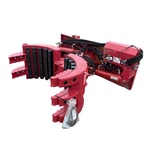
Fertilizer palletizing robot is an automatic control, reprogrammable, multifunctional, multi degree of freedom, spatial right angle relationship between motion degrees of freedom, and multi-purpose operating machine. Advantages: Heavy object palletizing. The advantages of palletizing machines are long service life, low failure rate, and unrestricted bag size. Automatically controlled, reprogrammable, all movements run according to the program. Flexible and multifunctional, with different functions depending on the operating tool. High reliability, high speed, and high precision. Can be used in harsh environments, can work for a long time, and is easy to operate and maintain.
1, Functional features:
1. Touch screen operation, easy to operate;
2. Simple structure, low failure rate, easy maintenance and upkeep;
3. There are few main parts, few accessories, and low maintenance costs;
4. Energy saving and environmentally friendly, low electricity consumption
5. Small footprint, adaptable to various working environments;
6. Can work continuously and stably for a long time.
2, Applicable fields:
In industries such as fertilizers, chemicals, building materials, feed, food, beverages, beer, new energy, glass, and plastic automation logistics, different grippers can be used to pack and stack finished products of various shapes in different industries.
3, Applicable packaging form:
Bagged, boxed, canned, boxed, bottled (non-standard grippers can be customized according to users)
4, Stacking form:
Flexible response to various palletizing requirements on site, non-standard palletizing forms can be designed according to user requirements.
In the era of mechanical intelligence entering production enterprises, integrated production lines for ingredients, packaging, and palletizing have gradually become an inevitable trend on the development path of enterprises. After years of independent research and development, combined with long-term practical experience in the fertilizer industry, Saimo Eagle Technology has continuously improved and developed specialized packaging equipment for multiple different fertilizers. It has been widely recognized by hundreds of fertilizer enterprises in China and has been widely accepted by customers.
Our company has independently developed core technologies, reliable product quality, strong applicability, and simple operation, among other comprehensive advantages, which have been recognized by many fertilizer enterprises. Its palletizing robot is widely used in the industry, with fast material handling speed, simple structure, low failure rate, easy maintenance, and convenient and flexible advantages. Packaging equipment can achieve full process automation from weighing, filling to bag making and packaging, with fast speed and high accuracy, which can increase production output and reduce labor for customers. It can achieve automation in weighing, bagging, bagging, folding, sealing, bag shaping, metal detection, weight re inspection, palletizing, pallet and tray transportation of powder, granules and block materials.
The fully automatic packaging machines, industrial robots, and supporting automated batching production lines produced by Saimo Eagle are at the leading level in China in terms of batching, packaging, palletizing equipment, and various technical indicators. The products are widely distributed throughout the country and exported to India, Bangladesh, Nigeria, Vietnam, Türkiye, Brazil, Indonesia and other countries. Not only used in the fertilizer industry, but also widely applied in automated production lines in industries such as chemical, building materials, feed, food, beverages, new energy, glass, and plastics.